



















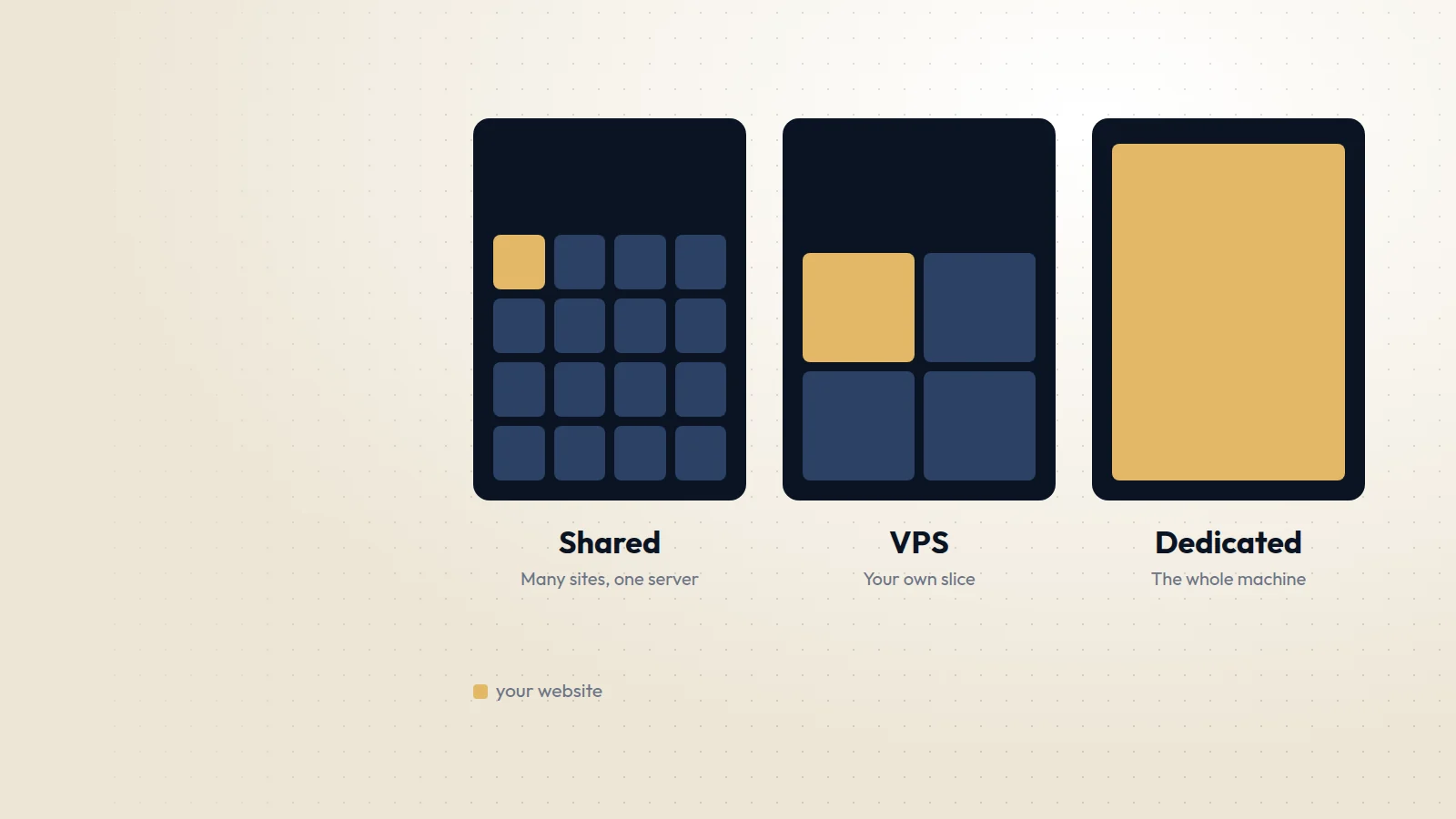
The original version of this article treated a dedicated server and a VPS as the same thing. They are not, and the difference matters when you choose where your site lives. Here is a clearer comparison of the three most common options.
Shared hosting
Your site lives on a server together with many other sites, all sharing the same processor, memory and disk. The provider manages the server, and you manage your site through a control panel.
- Lowest cost and easiest to start with.
- No server administration needed.
- Performance can suffer when other sites on the server are busy.
- Limited control over server software and settings.
Good for: small business websites, portfolios, landing pages and static sites with moderate traffic.
VPS (virtual private server)
A physical server is split into several virtual machines. Each VPS has its own guaranteed share of resources and its own operating system, isolated from the others.
- Predictable performance, because your resources are reserved.
- Full control over software versions, caching and configuration.
- Can usually be upgraded with more processor or memory in minutes.
- Needs someone to manage updates and security, unless it is a managed VPS.
Good for: growing business sites, online shops, multilingual portals, custom applications and agencies hosting several client sites.
Dedicated server
A whole physical machine is reserved for you. No other customers share the hardware.
- Maximum performance and isolation.
- Full control over hardware choices and configuration.
- Highest cost, and hardware upgrades take longer.
- Requires professional administration and monitoring.
Good for: high-traffic platforms, large databases, specialised security requirements and workloads that need consistent heavy processing.
Signs it is time to move up
- Pages slow down at busy times even after caching and image optimisation.
- The host warns you about resource limits or suspends processes.
- You need software versions or server settings the shared plan does not allow.
- You run an online shop or a portal where downtime directly costs money.
Cloud and managed options
Today many sites use cloud servers, which work like a VPS but can be resized or replicated quickly, and managed hosting, where a provider or agency looks after the server for you. For most of our clients, a managed VPS or cloud server in the EU is the best balance of speed, control and cost, without anyone in their business having to learn server administration.