

















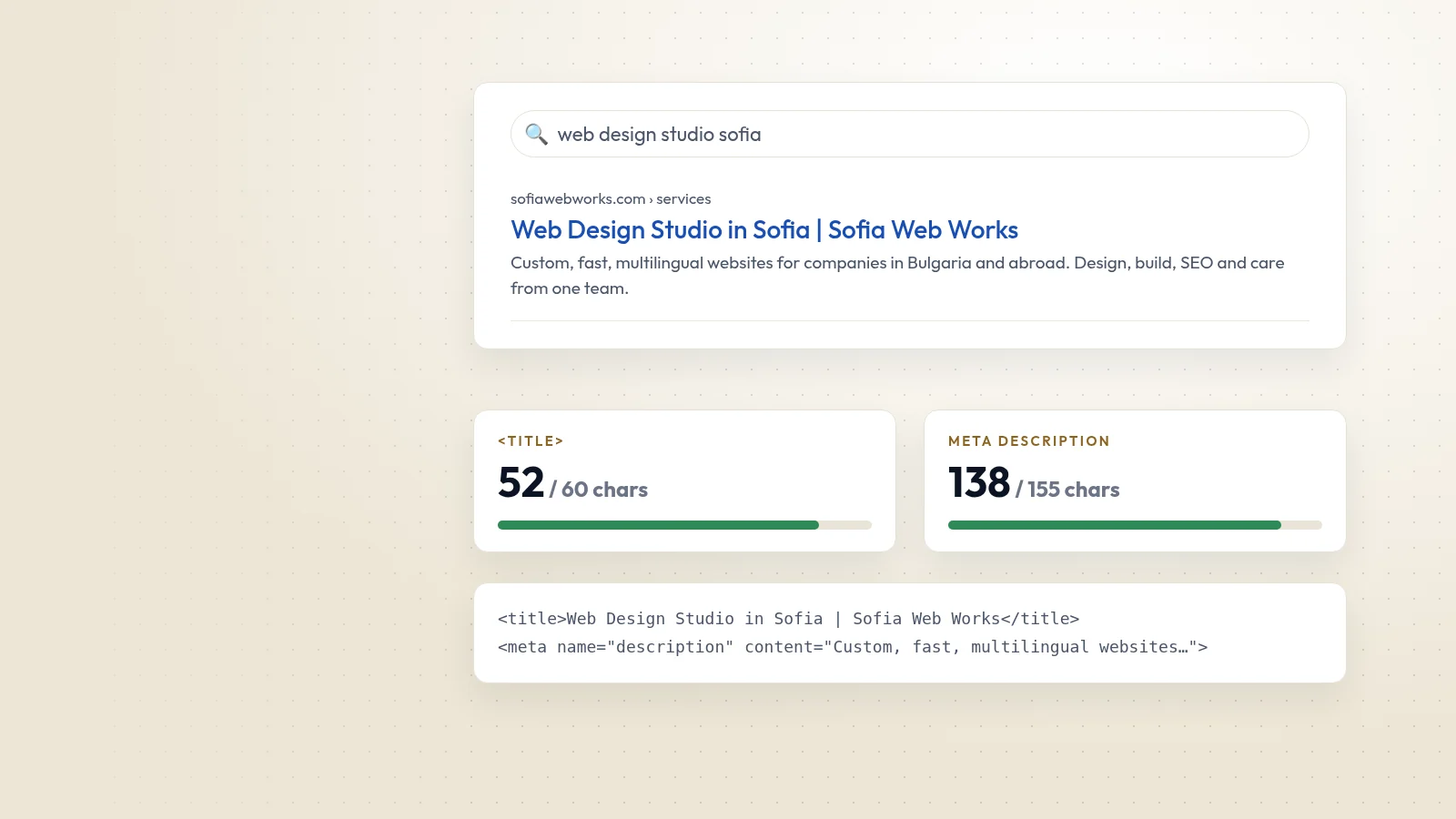
The title tag and the meta description are the first things a searcher sees of your page. The title is a confirmed ranking signal and the main headline in the search result. The description does not affect rankings directly, but a good one can noticeably improve how often people click.
Title tags
- Keep titles roughly within 50 to 60 characters. Google truncates by pixel width, so a title much longer than that is often cut off.
- Put the main topic near the beginning, in the words people actually search for.
- Add your brand at the end, separated by a pipe or a dash, if there is room.
- Make every title unique. Duplicate titles make it harder for search engines to choose the right page.
- Write for people. A title stuffed with keywords looks like spam and is less likely to be clicked.
A simple formula that works for most pages: main topic, a short qualifier, then the brand. For example: "Website Migration Without Losing Rankings | Sofia Web Works".
Meta descriptions
- Aim for about 140 to 160 characters, enough to make a clear point before the snippet is cut.
- Summarise what the page offers and why it is worth the click.
- Include the main phrase naturally; Google highlights words that match the search.
- Match the page. A description that promises something the page does not deliver increases bounces.
- Write a unique description for every important page.
Why Google rewrites snippets
Google often replaces the description, and sometimes the title, with text from the page when it thinks that better answers the specific query. This happens most when tags are missing, duplicated, too short or unrelated to the content. You cannot prevent it completely, but clear, accurate tags and a well-structured page make it much less frequent.
Other tags worth getting right
The meta keywords tag has been ignored by Google for many years, so there is no need to fill it. Open Graph tags (og:title, og:description and og:image) control how a page looks when it is shared on social media and messaging apps, and are worth setting on every page. On multilingual sites, write titles and descriptions natively for each language, not as literal translations.
Check and improve
Search Console shows impressions, clicks and click-through rate for every page and query. Look for pages with many impressions and a low click-through rate: they are already ranking, and a better title or description is often the fastest improvement you can make.